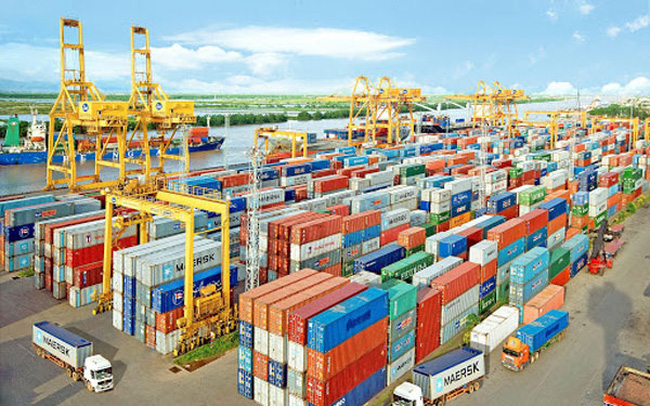
Data from the General Statistics Office shows that, in the context of the Covid-19 epidemic continuing to develop complicatedly, negatively affecting the world economy, but the import and export activities of Vietnam in the first 11 months of 2020 still achieved. a record trade surplus of 20.1 billion USD.
Total export and import turnover in 11 months was estimated at 489.1 billion USD, up 3.5% over the same period last year, of which exports reached 254.6 billion USD, up 5.3%; import reached 234.5 billion USD, up 1.5%.
In the first 11 months of 2020, the export turnover of goods of the domestic economic sector will reach 73 billion USD, up 1.6%, accounting for 28.7% of the total export turnover; foreign investment sector (including crude oil) reached 181.6 billion USD, up 6.9%, accounting for 71.3%.
Generally for 11 months of 2020, the import turnover of goods of the domestic economic sector reached 85.43 billion USD, down 9.6%; foreign invested sector reached 149.07 billion USD, up 9.2%.
Many economists believe that, in addition to the good signs, this trade surplus also revealed some worrying points. Because the trade surplus increased partly because imports fell. If imports continue to decline, it will create a shortage of input materials for the Vietnamese economy.
Currently, the global supply chain is threatened by epidemics, the COVID-19 epidemic is increasingly serious in the world and the risk of this disease is about to break out again this winter. , pushing the world economic crisis deeper.
Dr. Nguyen Duc Do - Deputy Director of the Institute of Economics - Finance (Academy of Finance), also expressed concern that the record surplus is mainly due to economic difficulties, people and businesses cut spending. spending on investment and consumption led to a sharp decline in imports.
Although the declining import trend has persisted for the past 10 months, it was only until November that the situation improved with a 1.5% increase over the same period last year. In which, mainly imported materials for production, accounting for 93.3% of total import turnover. This is a good signal that the international commodity manufacturing supply chain is gradually reconnecting. However, the fact that imports is still growing slowly and this shows that domestic production has not really recovered completely.
The fact is that imports are still growing slowly and this shows that domestic production has not really fully recovered.
Looking at the statistics also shows that, in terms of commodity export markets, the United States is the largest export market of Vietnam in 11 months with a turnover of $ 69.9 billion, up 25.7% over in the same period last year. Next is China with 43.1 billion USD (up 16%); EU market reached 32.2 billion USD, down 2.4%. ASEAN market reached 20.9 billion USD, decreased by 10.6%. South Korea reached 17.7 billion USD, down 2.7%. Japan reached 17.3 billion USD, down 6.5%.
Thus, the trade surplus in 11 months is at a very high level, but mainly due to the growth of exports to the US and China markets. Meanwhile, exports to the EU and some markets such as ASEAN, Korea, and Japan all fell from 3% to 10%.
With this structure, in the context of the current COVID-19 situation, it is still acceptable, but in the long run, it may lead to "dependence" on several markets, leading to export growth and export surplus. unsustainable.
The opportunities and challenges from the FTA Agreements, especially the recently signed Regional Comprehensive Economic Partnership (RCEP), are clearly analyzed. Many partners in RCEP have a similar product structure to Vietnam, with strong competitiveness such as China, Thailand, Indonesia, ... will lead to more fierce competition in the whole market. export and domestic.
Besides, there are also concerns about how difficult it is to improve and harmonize the trade balance with the countries in the Agreement when Vietnam is having trade deficit from many countries such as China, South Korea, and ASEAN countries. are exporting to America. And the trade defense measures, investigation against tax evasion, origin fraud, ... not only in the US market but also in other markets in the future will be a risk to Vietnamese businesses.